Bill of Lading (B/L) Explained: Purpose, Functions, and Sample Form SEO Description Port fees piling up? See What is a Bill of Lading, Master vs House, Original vs Telex—match docs, release China cargo fast. What is a Bill of Lading isn’t a classroom question when your China container lands and nobody can pick it up. […]
Bill of Lading (B/L) Explained: Purpose, Functions, and Sample Form
SEO Description
Port fees piling up? See What is a Bill of Lading, Master vs House, Original vs Telex—match docs, release China cargo fast.
What is a Bill of Lading isn’t a classroom question when your China container lands and nobody can pick it up. One typo on consignee, one wrong release choice, and the port meter starts running—demurrage, storage, the whole ugly tab.
FastShip China documentation engineers draft it; export ops managers verify weights, routing, release.
This guide shows what the B/L legally does, how Master vs House and Original vs Telex change control, and which lines to match against your invoice and packing list, so your cargo gets released clean—no drama, no ransom-like fees—just on-time delivery.
What Is a Bill of Lading?
If you’re asking What is a Bill of Lading, think of it as the paperwork that keeps sea freight honest. It explains who ships, who carries, and who gets paid, so cargo doesn’t end up in a mess.
Understanding the Contract of Carriage
What is a Bill of Lading when you strip it down. It’s proof of a Contract of Carriage that ties the Shipper to the Carrier, with the Consignee waiting at the other end. Miss the fine print and you can get burned fast.
Core players and promises
Shipper responsibilities
Provide correct cargo details and packing marks; wrong info can break the Terms and Conditions.
Pay as agreed under the Freight Agreement, not when it “feels right.”
Carrier responsibilities
Move cargo on the stated route for sea freight or multimodal moves under the Contract of Carriage.
Apply liability limits and claim rules stated in the Terms and Conditions.
What the B/L usually nails down
Routing and handoffs
- Port-to-port vs door-to-door language affects who’s on the hook during transfers.
Delivery and release rules
- If the Consignee can’t show what’s required, cargo can sit while fees tick up.
If you’re still circling What is a Bill of Lading, FastShip China often explains the Contract of Carriage in plain language before booking, so you’re not guessing later.
How a B/L Serves as a Document of Title
What is a Bill of Lading in trading terms. It can act as a Document of Title, meaning control of the Goods can track whoever holds the right paperwork, not whoever is shouting the loudest on the phone.
Quick list of how it plays out:
The original B/L represents Possession rights to the Property in transit.
Endorsing and handing over originals can trigger Transfer of Title and shift Ownership.
Banks like this setup because it supports safer payment flows.
1) Seller ships Goods and receives originals.
2) Buyer pays (or bank accepts terms), then gets the originals.
3) Buyer presents documents and claims cargo at destination.
| Scenario | Originals held by | Control outcome |
|---|---|---|
| Open account (high trust) | Buyer early | Buyer can claim cargo sooner |
| Cash against documents | Seller/bank | Buyer gets control after payment |
| Letter of credit | Bank (temporarily) | Control follows compliant docs |
| Dispute on quality | Seller retains | Transfer of Title may pause |
| Lost originals | Nobody | Release may require guarantees |
So, What is a Bill of Lading here. A practical handle on Ownership, not just a receipt. FastShip China can also advise when a paper B/L is worth it versus faster release options.
Negotiable vs Non-Negotiable Bill of Lading
What is a Bill of Lading when money risk is on the table. The answer changes depending on Negotiable B/L versus Non-Negotiable B/L, since Transferability controls who can legally demand delivery.
Negotiable B/L basics
Holder rights
- Whoever becomes the lawful Holder can claim cargo, typically after Endorsement.
Why sellers like it
- Title stays “locked” until payment clears, since Transferability is built in.
Non-Negotiable B/L basics
Named delivery
- A Non-Negotiable B/L points to a specific Consignee, with fixed Delivery Instructions.
Operational upside
- Fewer document handoffs, and release can be smoother with options like telex release depending on carrier rules.
Symbols that matter in real life:
✓ Use Negotiable B/L when you need payment security before release.
✓ Use Non-Negotiable B/L when the buyer is trusted and speed matters.
What is a Bill of Lading at closing time. It’s the switch that decides how cargo gets released, who proves the right to collect, and how much stress you’ll have at the destination desk.
Parties Involved in a Bill of Lading
Bill of Lading talk gets messy fast because names overlap and everyone swears they’re “the shipper.” This clears up who signs what, who gets notified, and who the carrier answers to when Customs Clearance starts asking questions.
Role of Shipper, Freight Forwarder, and Exporter
What is a Bill of Lading really about here? It’s about the party on paper who has rights and duties, not just who packed the cartons. The Exporter might be the factory selling goods, but the Shipper (also called Consignor, Sender, or the Principal) is the contracting name shown on the bill of lading document, and that detail can decide who gets chased when details don’t match.
When a Freight Forwarder sits in the middle, the story splits. One side is the carrier-facing booking, and the other side is the customer-facing proof of shipment; that’s why a forwarder may issue a House Bill of Lading while still relying on a carrier’s master B/L. If you’re asking What is a Bill of Lading, this is the moment it stops being theory and turns into a shipping document that banks, customs, and receivers actually argue over.
Quick reality check:
Exporter supplies and sells the goods.
Shipper appears on the B/L and “owns” the shipment instruction trail.
Freight Forwarder coordinates booking, documents (like Commercial Invoice), and handoffs—FastShip China often gets pulled in here when timelines are tight.
Consignee, Notify Party, and Importer Explained
What is a Bill of Lading used for on arrival day? Control. The Consignee (also Recipient, Receiver, or Beneficiary) is the named party meant to receive cargo, and with an Original Bill of Lading, that name can be tied to title and release.
Here’s how the roles normally shake out, without the fancy talk:
Consignee: the one the carrier releases to—if the paperwork matches and the B/L rules are met.
Notify Party: gets pings and arrival notices; no automatic right to pick up cargo.
Importer: handles the messy end—Import Declaration, duty and tax payment, local trucking, and “why is customs holding my pallet?”
A plain-English hint: if someone asks “what is a Bill of Lading,” tell them it’s the receipt plus the rulebook for who can claim the freight. FastShip China can prep the handover checklist so the Importer isn’t scrambling at the terminal gate.
Common mix-ups
People list the Notify Party as the Importer; sometimes true, often not.
The Consignee may be a bank or a buyer, depending on payment terms.
Carrier Responsibilities in Customs Clearance and Cargo Tracking
What is a Bill of Lading to the Carrier (the Shipping Line / Ocean Carrier / Transport Company)? A promise to move the box and report it properly, plus a duty to release it only under the B/L’s rules. That promise turns into real tasks that touch Cargo Tracking and Customs Clearance.
Responsibilities, broken down by what actually happens:
Data and filings (before arrival)
Manifest and shipment data submission
1) Container number linkage to B/L
2) Port of loading/discharge accuracy
3) Party name consistency (shipper/consignee)
Movement and visibility (during transit)
Cargo Tracking events the customer watches
• Gate-in / loaded-on-vessel
• Transshipment / rolled shipment updates
• Discharge confirmation at port
Release and exceptions (at destination)
Proper release at Port of Discharge
a. Verify surrender/originals or telex release rules
b. Hold cargo if documents or holds require it
c. Report container status and damage notes
| Carrier task (B/L-linked) | Typical timing (days) | Risk if wrong (1–5) | Common fix time (days) |
|---|---|---|---|
| Submit manifest/ENS/ACI data | 1–3 pre-arrival | 4 | 1–2 |
| Update milestone scans for Cargo Tracking | 0–2 per event | 2 | 1 |
| Release after holds cleared | 0–5 post-arrival | 5 | 2–7 |
If you keep asking What is a Bill of Lading, this table is the punchline: a B/L is only as good as the carrier’s data trail and release control. A good Logistics Provider like FastShip China can chase missing updates, but the Carrier still owns the official record.
Types of Bill of Lading
If you’re asking, “What is a Bill of Lading,” you’re really asking who controls the cargo, who takes the risk, and how delivery gets unlocked. Below, “bill,” “of,” and “lading” show up in real-world paperwork across ocean and air moves.
Master Bill of Lading Key Features
What is a Bill of Lading in ocean shipping when a vessel is involved? The Master version is the carrier-facing “bill of lading” that anchors the sea leg, and it’s usually where disputes end up landing.
Parties and ports that must line up
Carrier issues it to the Shipper (often the forwarder acting as shipper) and names the Consignee.
Port of Loading and Port of Discharge need to match the actual routing, not the “sounds right” routing.
Cargo identity that stops arguments later
Description of Goods should be specific enough for customs and claims.
Number of Packages must reflect what’s physically tendered, not a guess from a packing list.
What it practically “does”
- It sets carrier liability and the handover point at the discharge side, so a clean copy is worth chasing early, not at the last minute with FastShip China on the phone.
House Bill of Lading for Freight Forwarders
When people say “What is a Bill of Lading” for consolidation, they usually mean the House “bill of lading.” It’s the forwarder’s promise, not the ocean line’s.
1) Freight Forwarder issues the document to the Actual Shipper, then routes delivery to the Actual Consignee using clear Delivery Instructions.
2) In Consolidation, multiple shippers ride under one master, so your House record is the one your customer stares at.
3) Lock in Shipment Details early (weights, cartons, marks), then keep a single Tracking Number that customer service can repeat without fumbling.
Quick check:
If your buyer asks “what is bill of lading used for,” the House answer is simple: proof of forwarder-arranged carriage and the delivery roadmap.
FastShip China typically pushes clients to reconcile House vs. Master fields before sailing, because fixing it after arrival is a headache.
Seaway Bill for Ocean Freight
A Seaway “bill of lading” is built for speed because it’s non‑negotiable, so release isn’t gated by couriered originals. If you’re still stuck on “What is a Bill of Lading,” think of this as the streamlined cousin.
Identity and voyage controls
Ocean Carrier confirms Shipper Name and Consignee Name for straight release.
Vessel Name and Voyage Number tie the document to a specific sailing.
Routing clarity
- Port of Origin and Port of Destination drive where the cargo can be claimed.
When it fits (and when it doesn’t)
Fits: trusted trade lanes where you don’t need title transfer via paper.
Doesn’t: deals where the bank, not the buyer, calls the shots.
Air Waybill in Multimodal Transport
“What is a Bill of Lading” in air? The Air Waybill is not a title document, but it’s the backbone for handoffs, tracking, and customs entries across modes, especially when FastShip China stitches air + truck moves together.
Core identifiers
Airline and Issuing Agent show who accepted the freight.
Origin Airport, Destination Airport, and Flight Number keep the route honest.
Nature and Quantity of Goods plus Declared Value shape screening and liability expectations.
| Metric (typical) | Air Waybill | Master Bill of Lading | House Bill of Lading | Seaway Bill |
|---|---|---|---|---|
| Negotiable (1=yes, 0=no) | 0 | 1 | 1 | 0 |
| Original paper needed for release (1/0) | 0 | 1 | 1 | 0 |
| Common legs covered (count) | 1 | 1 | 1–3 | 1 |
| Avg. doc turnaround (days) | 1 | 3 | 2 | 1 |
If someone asks “what is a bill of lading” for multimodal visibility, the plain answer is: air uses the Air Waybill for movement proof, while sea relies on the bill of lading family for control and release.
Key Elements on a Bill of Lading
Quick refresher on What is a Bill of Lading: it’s the shipping paper that keeps cargo, payment, and responsibility from getting messy. If you’re asking “bill of lading what is it,” this is the cheat sheet. FastShip China keeps these fields tight so cargo doesn’t get stuck.
Goods Description, Container Number, and Seal Number
When someone asks What is a Bill of Lading, the boring-looking Goods Description is a big part of the answer. It’s your Cargo Details in plain words, and Customs reads it like a receipt.
Goods Description and Product Identification
Match wording to the invoice and packing list; “parts” is vague, “steel valve parts” is clearer.
Add Package Type (cartons, crates) so the count makes sense.
Container Number
Treat the Container Number like the cargo’s license plate; one wrong digit can send the box on a joyride.
Keep Shipping Marks consistent across paperwork.
Seal Number
The Seal Number is your tamper clue; mismatches can spark inspections and ugly arguments.
If a seal changes, record it fast and explain why—FastShip China can flag this before the vessel sails.
You’ll hear What is a Bill of Lading explained as “title plus receipt,” but in day-to-day slang it’s also the “don’t-let-anyone-freak-out later” document.
Gross Weight, Volume, and Number of Packages
What is a Bill of Lading used for in pricing? A lot rides on Gross Weight, Volume, and Number of Packages.
1) Check weights
- Gross Weight includes packaging; Net Weight doesn’t. Don’t mix them up.
2) Check cube
- Volume in Cubic Meters drives space planning, especially on tight sailings.
3) Check count
- Number of Packages should match reality: Cartons vs Pallets changes handling.
Quick sanity checklist:
• If the packing list says 20 Pallets, the B/L can’t say 200 Cartons unless that’s truly how it’s shipped.
* If Gross Weight jumps, ask why before Customs does.
2) If Cubic Meters looks “rounded,” re-measure; rounding gets expensive.
This is the “bill of lading definition” part people learn after a surprise fee.
Place of Receipt, Place of Delivery, Origin Port vs Destination Port
If you’re still asking What is a Bill of Lading, look at location fields; that’s where responsibility quietly shifts.
Inland endpoints
Place of Receipt
Where the carrier takes charge before the ocean leg, often a warehouse or rail ramp.
Ties to pickup risk in multimodal moves.
Place of Delivery
- Where the carrier’s job ends inland, not always the same as the discharge port.
Ocean ports
Port of Loading (your Origin port)
- May show the Loading Terminal too; that matters for cutoff timing.
Port of Discharge (your Destination port)
- Can include the Discharge Terminal, which affects where the box is actually retrievable.
FastShip China usually double-checks these against routing notes so the B/L doesn’t accidentally promise the wrong end point.
FOB to DDP Incoterms Snapshot
A practical way to answer What is a Bill of Lading is: it reflects the deal logic behind Incoterms and who pays for what.
Minimal seller duty
EXW (common shorthand in Trade Terms talk)
- Buyer handles pickup onward; seller mainly makes goods available.
Port handoff
FOB
- Responsibility Transfer happens at the port once loaded; the export side still needs clean documents.
Seller arranges main carriage
CIF
- Seller pays ocean freight plus insurance; the B/L still must show correct parties and ports.
Destination-side delivery
DAP vs DDP
DAP delivers to place, buyer clears import.
DDP delivers cleared, duty paid; the strictest Cost Allocation for the seller.
If your team keeps asking “What is a Bill of Lading,” it’s often because the FOB/DDP choice wasn’t crystal clear.
Choosing Between Freight Prepaid and Freight Collect
When people ask What is a Bill of Lading in payment terms, they’re really asking about Freight Prepaid vs Freight Collect—who gets the Freight Charges bill.
| Option | Who pays the carrier | Cash-flow feel | Typical fit |
|---|---|---|---|
| Freight Prepaid | Shipper | Money out early, fewer surprises | CIF, many DAP moves |
| Freight Collect | Consignee | Pay on arrival, can sting at pickup | Some FOB deals |
| Prepaid Freight (noted on B/L) | Shipper | Cleaner release process | When seller wants control |
| Collect Freight (noted on B/L) | Consignee | Can delay release if unpaid | When buyer controls booking |
A quick, street-smart way to pick:
If you want smoother destination release, lean Freight Prepaid and align Payment Responsibility with the sales contract.
If the buyer insists on controlling Shipping Costs, Freight Collect can work, but confirm the consignee can pay on time.
FastShip China can set the B/L wording so “prepaid” and “collect” don’t get mixed up at destination—because that’s when the “bill of lading what is it” question turns into a late-night phone call.
Core Functions of the Bill of Lading
Quick intro: What is a Bill of Lading in real life shipping talk. It’s the Bill of Lading you’ll hear about in every booking, payment, and release call, because it ties the deal together. FastShip China keeps it simple, but never casual about the details.
Bill of Lading as a Contract of Carriage
If you’re still asking, What is a Bill of Lading, start here: it’s where the Carrier and Shipper lock in the “who does what” for the trip, and it’s not just vibes, it’s enforceable paper. What is a Bill of Lading also means you’re accepting the Terms and Conditions that decide how disputes get handled when cargo goes sideways.
Parties and roles
Carrier duties
Provide space for the Freight and run the Voyage as booked, unless the fine print allows changes.
Apply liability limits that can matter a lot if cartons get wet or crushed.
Shipper promises
- Tender cargo and paperwork that match what’s declared, so the Consignee isn’t stuck at release time.
Route and handover points
Port of Loading commitments
- Cut-off times, documentation deadlines, and what counts as “received.”
Port of Discharge expectations
- Where responsibility typically flips toward delivery arrangements and local handling.
Why this helps in a fight
Late delivery or damage claims
- The B/L anchors what was agreed, instead of relying on memory or chat logs.
Commercial clarity
- When someone asks “what is bill of lading coverage,” the contract language answers it fast.
Serving as a Receipt of Goods
What is a Bill of Lading as a receipt. It’s the Carrier’s Acknowledgment that cargo was taken in, on a specific Date of Shipment, with stated Quantity and a stated Condition of Goods.
Basic checks people actually use
Match Goods Description to invoices so a bank doesn’t kick it back.
Align Packaging and Marks and Numbers with cartons and labels at the dock.
Confirm Loading Port is right, because a typo can cause a real customs headache.
Clean vs. not-so-clean
“Clean” means no visible issues noted.
Claused means the paperwork flags dents, torn wrap, or short count, and that can mess with payment.
“Clean” transport documents still matter because banks examine documents, not cargo, under documentary credit practice; a small discrepancy can trigger delays or refusal. — ICC Banking Commission commentary updates (2024)
FastShip China will usually push you to fix mismatches early, because what is a bill of lading worth if it can’t survive document checking.
Document of Title: Why It Matters
What is a Bill of Lading beyond shipping proof. It can function as Ownership control, since the Holder of an original can often control Delivery, and that changes how risk and payment behave.
Control and transfer
Negotiability basics
- If structured to be negotiable, it can move with endorsement, enabling Transferability across a sale chain.
Practical impact
- The Consignee might not be able to pick up cargo without the right original in hand.
Financing muscle
Pledge and Security Interest
- Banks may treat the document as part of collateral control when money is on the line.
Third-party effects
- A Third Party buyer can gain rights depending on how the document was transferred.
Street-level takeaway
What is a Bill of Lading for sellers
- It slows down release until money is settled, if you keep originals tight.
Original B/L vs Telex Release
What is a Bill of Lading choice at release time. It’s usually a fork: Original Bill of Lading control, or speed via Telex Release, and your risk mood decides.
Original route (stronger control)
How it works
- The buyer presents signed originals; only then does the line issue a Delivery Order.
Where it bites
- Courier delays can stall pickup at the Discharge Port, even if Customs Clearance is ready.
Telex route (faster flow)
How it works
- Originals are Surrendered at origin; the line confirms Electronic Release to destination.
Trade-off
- Sellers lose some grip, since goods can be released without originals moving around.
Bank and compliance reality
Bank Requirements
- Some deals still demand originals, so “what is bill of lading release” becomes a bank-driven question.
Picking smart
- If you need speed and trust the buyer, Telex is clean and quick; if payment feels shaky, originals are the safer bet, and FastShip China can help keep the handoffs disciplined.
Bill of Lading in Logistics Processes
What is a Bill of Lading comes up all the time because it’s the paper trail that keeps bookings, customs, and delivery from going sideways. This quick guide keeps it plainspoken: what is a bill, what is lading, and how FastShip China uses clean data so small mistakes don’t snowball.
From Booking Confirmation to Container Loading
What is a Bill of Lading if not the “source of truth” that starts with Booking Confirmation and ends with Container Loading. Miss one field, and the mess spreads.
Intake flow tied to Vessel Schedule and Cargo Readiness
From Booking Confirmation to Shipping Instructions
Confirm Port of Loading matches the booking
Lock the right Equipment Type (don’t guess)
From Shipping Instructions to draft B/L
- Check cargo description wording now, not later
Physical load-out at Container Loading
Container identifiers
- Container Number and Seal Number must match what gets stuffed
Weights and packing
- Net, gross, and package count aligned before the cut-off
What is a Bill of Lading doing here, day-to-day. Acting like a checklist you can’t afford to “eyeball,” especially when FastShip China is expected to hand over a clean file.
Navigating Export Declaration and Import Declaration
What is a Bill of Lading used for in filings. A lot.
Export Declaration setup
Match Shipper Information to your invoice header
Keep Country of Origin consistent across docs
Import Declaration prep
Validate Consignee Information exactly as the Customs Authority expects
Tie commodity lines to Harmonized System (HS) Code logic, not vibes
Quick sanity checks (low effort, big payoff)
Packages: same count on B/L, invoice, packing list
Description: no “general cargo” shortcuts
Units: kg vs lb—pick one and stick to it
What is a bill of lading in this context. It’s the bridge between trade docs and clearance, and FastShip China pushes for one wording set so rejections don’t ping-pong.
Customs Clearance and Real-Time Cargo Tracking
What is a Bill of Lading worth at the border. It’s the anchor for Customs Clearance, then it feeds Cargo Tracking updates the buyer actually cares about.
Clearance dependencies
Documentation Review
B/L vs invoice vs packing list alignment
Manifest-ready formatting before submit
Money side
- Duty and Taxes estimates depend on the same declared facts
Tracking milestones linked to risk
Ports and timing
Port of Discharge scan confirms arrival logic
Transit Time variance flags congestion
Final leg
- Delivery Status is where demurrage surprises usually show up
| Milestone event | Typical lag (hours) | Visibility score (1–5) | Cost risk level (1–5) |
|---|---|---|---|
| Gate-in at origin | 2 | 4 | 2 |
| Loaded on vessel | 12 | 3 | 3 |
| Discharged at POD | 18 | 4 | 4 |
| Customs release | 24 | 2 | 5 |
| Out for delivery | 8 | 4 | 3 |
What is lading really doing here. Keeping FastShip China and the importer on the same page when clocks are ticking.
Enhancing Multimodal Transport Efficiency
What is a Bill of Lading in Multimodal Transport. It’s the one doc that keeps handoffs from turning into finger-pointing.
Routing clarity across nodes
Place fields that stop confusion
Place of Receipt sets the pickup responsibility
Place of Delivery defines the “done” line
Network reality
- Transit Hub choices shape dwell time inside the Logistics Network
Handover accountability
Who touches the freight, and when
Freight Forwarder coordinates Intermodal Connectivity
Each Mode of Transport needs matching timestamps and references
Ops payoff
Cleaner claim paths through Supply Chain Integration
Fewer duplicate documents, fewer “wait, which version” moments
What is a Bill of Lading doing for multimodal moves. Cutting noise, tightening responsibility, and helping FastShip China keep transfers smooth without drowning you in paperwork.
Sample Bill of Lading Form and Tips
A lot of people ask, “What is a Bill of Lading” right when paperwork starts piling up. This cluster keeps it practical: match the docs, spot the usual slip-ups, and keep cargo details consistent.
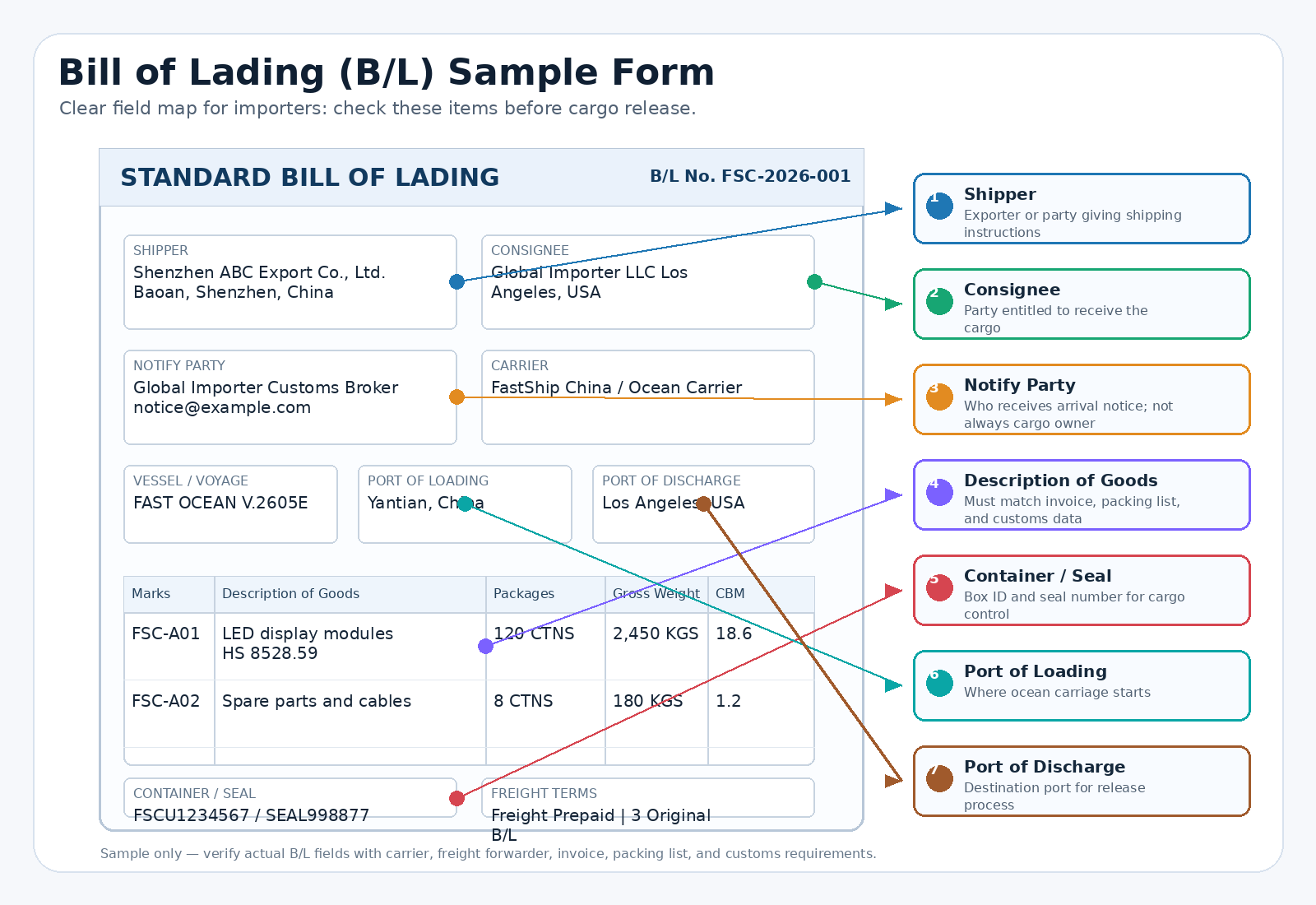
Annotated Sample B/L with Commercial Invoice and Packing List
If you’re still asking, “What is a Bill of Lading,” treat it like a deal memo plus a receipt. Then do the boring part: align it with the Commercial Invoice and Packing List, field by field, so nobody’s guessing later.
Core match-ups across documents (keep the same spelling, same punctuation, same order):
Parties
Shipper Information
Use the exact legal name from the Commercial Invoice (not a nickname from an email thread).
Consignee Information
Mirror the consignee name and address as shown on the Packing List, especially the city line.
Cargo details
Description of Goods
Match product wording across the Bill of Lading, Commercial Invoice, and Packing List; avoid “parts” if the invoice says “steel valve assemblies.”
Counts and measures
Package count should reconcile to the packing list totals; weights should not “round themselves” on the B/L.
Routing and timing
Port of Loading
Confirm it matches the booking and export docs; one wrong port code can stall everything.
Port of Discharge
Check discharge port vs final delivery place so the carrier release doesn’t get messy.
Quick “does it make sense?” checks before release:
Incoterms and freight terms don’t fight each other.
Dates line up with the sailing plan, not yesterday’s draft.
And yes, when someone asks again “What is a Bill of Lading,” this is the real answer: it’s only “right” when it matches the other paperwork.
5 Common Tips for Accurate B/L Completion
People google what is a bill of lading because the small details bite. Here are the fixes that save you from the classic back-and-forth.
Correct Parties: use exact legal names, no shortcuts, no “c/o” surprises unless the invoice shows it.
Accurate Description: keep the Description of Goods consistent with the Packing List and invoice; don’t freestyle.
Number of Packages, Weight and Volume: if cartons = 120 on the packing list, don’t let the B/L say 100 “approx.”
Incoterms: sanity-check trade terms against freight payment—this is where “Freight Prepaid” vs collect gets awkward fast.
Harmonized System (HS) Code and Shipping Marks: include them when required, and keep marks readable, because warehouses run on marks, not vibes.
Tiny red-flag list:
Wrong Port of Loading or Port of Discharge
Mixed release method/negotiability instructions
What is a Bill of Lading in plain talk? A document that has to agree with every other document, or you’ll be stuck fixing it at the worst possible time.