SEO Description Cheap freight quotes collapse fast when duties hit. This DDP vs DAP cost breakdown reveals who really pays—and who panics. The DDP vs DAP cost breakdown is where cheap quotes go to die—because the fine print, port fees, and duty surprises always show up. In 2025, FastShip China’s operations director emphasized in company […]
SEO Description
Cheap freight quotes collapse fast when duties hit. This DDP vs DAP cost breakdown reveals who really pays—and who panics.
The DDP vs DAP cost breakdown is where cheap quotes go to die—because the fine print, port fees, and duty surprises always show up.
In 2025, FastShip China’s operations director emphasized in company guidance that strict HS code accuracy and clear duty allocation decide who really pays.
Pick wrong, and your cargo stalls, cash gets locked up, and someone writes a painful check. That’s the reality today.
Quick Insights on DDP vs DAP cost breakdown
➔ Freight & Transportation: DDP covers end-to-end carriage to consignee’s premises; DAP stops at the destination, excluding import clearance and last-mile fees.
➔ Duty & Tax Burden: Under DDP, the seller pre-pays import duties and VAT; with DAP, the importer assumes HS code risk and tax payments.
➔ Risk & Storage Exposure: DDP shifts demurrage, detention, and customs compliance to the exporter; DAP leaves these post-arrival costs to the buyer.
➔ Cash Flow Impact: DDP demands upfront payment of freight and duties; DAP offers lower initial costs but hides downstream charges.
Cost Structure Comparison: DDP vs DAP
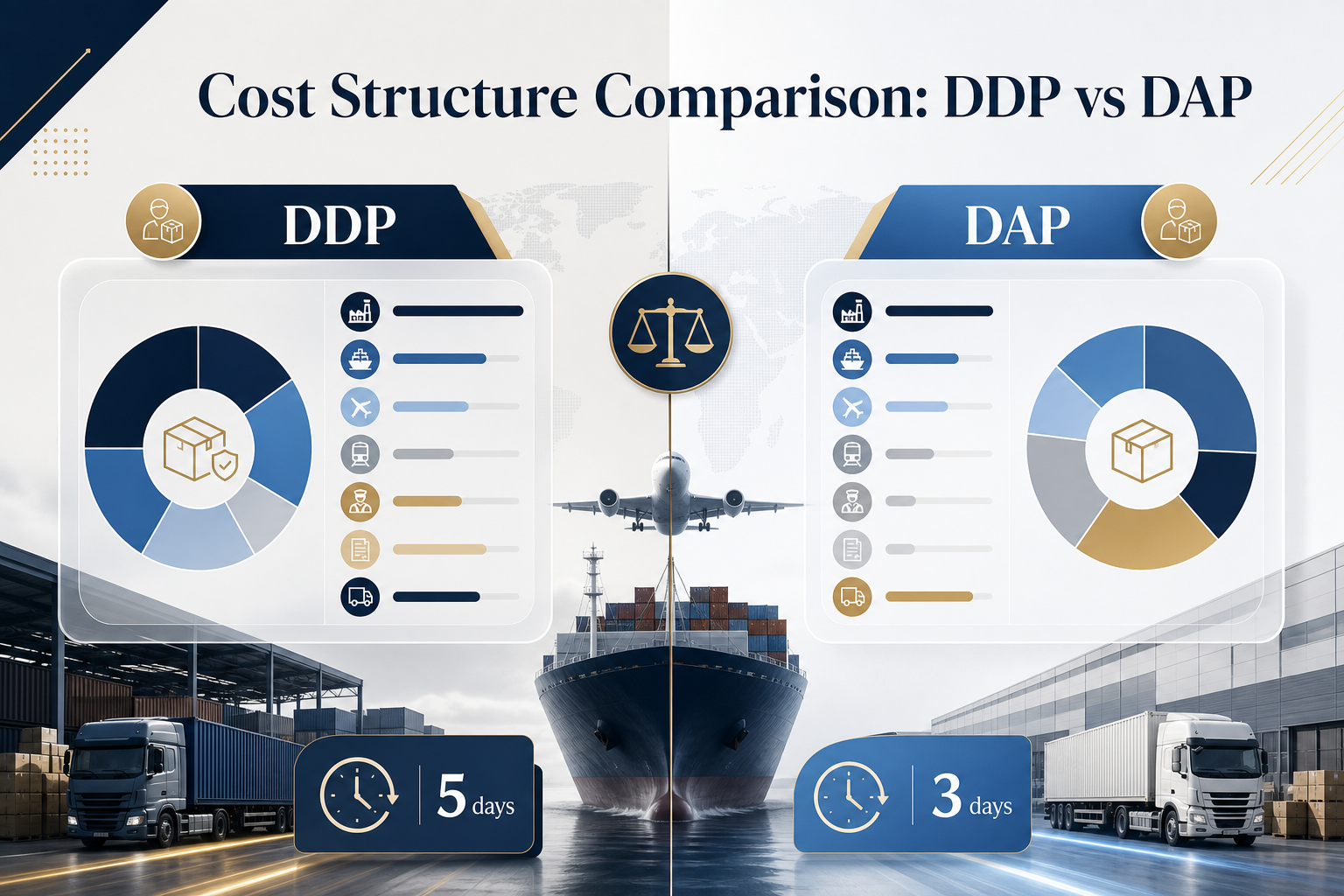
When people search for a clear DDP vs DAP cost breakdown, what they really want is straight talk about money and risk. The debate isn’t abstract; it’s about who pays, who clears customs, and who deals with surprises. Below is a practical DDP and DAP cost comparison that keeps things simple and grounded.
Freight and Transportation Costs
In any DDP vs DAP cost breakdown, freight sits at the core. The split begins with responsibility.
-
Under Delivery Duty Paid, the seller handles:
-
Ocean freight
-
Inland haulage
-
Multimodal transfers to the Final Destination
-
-
Under Delivery at Place, the seller pays transport to the named place, but stops short of import clearance.
From a structured view:
-
Seller Responsibility (DDP)
-
Books main carriage
-
Covers destination trucking
-
Manages transit risk until delivery
-
-
Buyer Responsibility (DAP)
-
Takes over at Arrival at Destination
-
Arranges unloading
-
Prepares for import formalities
-
In a real-world DDP DAP breakdown, freight quotes may look similar upfront. The twist comes later when destination handling fees sneak in under DAP. Many importers working with FastShip China compare DDP vs DAP pricing structure early to avoid sticker shock.
Customs Duties and Tax Exposure
Customs is where the DDP vs DAP cost conversation gets serious.
Under Delivery Duty Paid, the exporter absorbs Import Duties, Taxes, and full Customs Clearance risk. That includes HS classification, valuation checks, and possible audits. Cash flow pressure is real.
Under Delivery at Place, the buyer controls Import Formalities, pays duties, and manages local Customs Brokerage. This shifts compliance exposure but can reduce seller pricing buffers.
Key contrasts in a DDP vs DAP total cost review:
-
★ DDP = seller funds duty + VAT
-
★ DAP = buyer pays upon entry
-
★ Risk Transfer happens earlier in DAP
For companies new to cross-border trade, the DDP and DAP cost comparison often comes down to tax predictability versus control.
Terminal and Port Charges
Terminal fees can wreck a poorly planned DDP vs DAP cost breakdown. The numbers below show a simplified comparison (USD, 40HQ example):
| Charge Type | DDP Paid By | DAP Paid By | Avg. Cost (USD) |
|---|---|---|---|
| Terminal Handling (THC) | Seller | Seller | 320 |
| Port Security Fee | Seller | Seller | 45 |
| Customs Inspection | Seller | Buyer | 180 |
| Demurrage (5 days) | Seller | Buyer | 500 |
| Storage (3 days) | Seller | Buyer | 210 |
Under DDP, unexpected inspections stay within Seller Responsibility. Under DAP, once goods reach port and await clearance, storage and inspection costs often move to the importer. A tight DDP vs DAP cost breakdown must factor time, not just freight.
Last Mile Delivery Expenses
The last stretch shapes the final DDP and DAP cost comparison.
In DDP:
-
Seller arranges truck dispatch
-
Covers fuel surcharges
-
Delivers to the agreed Final Destination
In DAP:
-
Goods arrive at destination point.
-
Buyer handles unloading.
-
Local trucking is arranged by the importer.
This affects the DDP vs DAP total cost more than many expect. A missed delivery slot or warehouse delay can add re-delivery charges fast.
Brands like FastShip China often advise clients to review unloading capacity and local transport rates before locking in a DDP vs DAP cost breakdown. One clean quote beats three surprise invoices later.
Operational Responsibility Breakdown
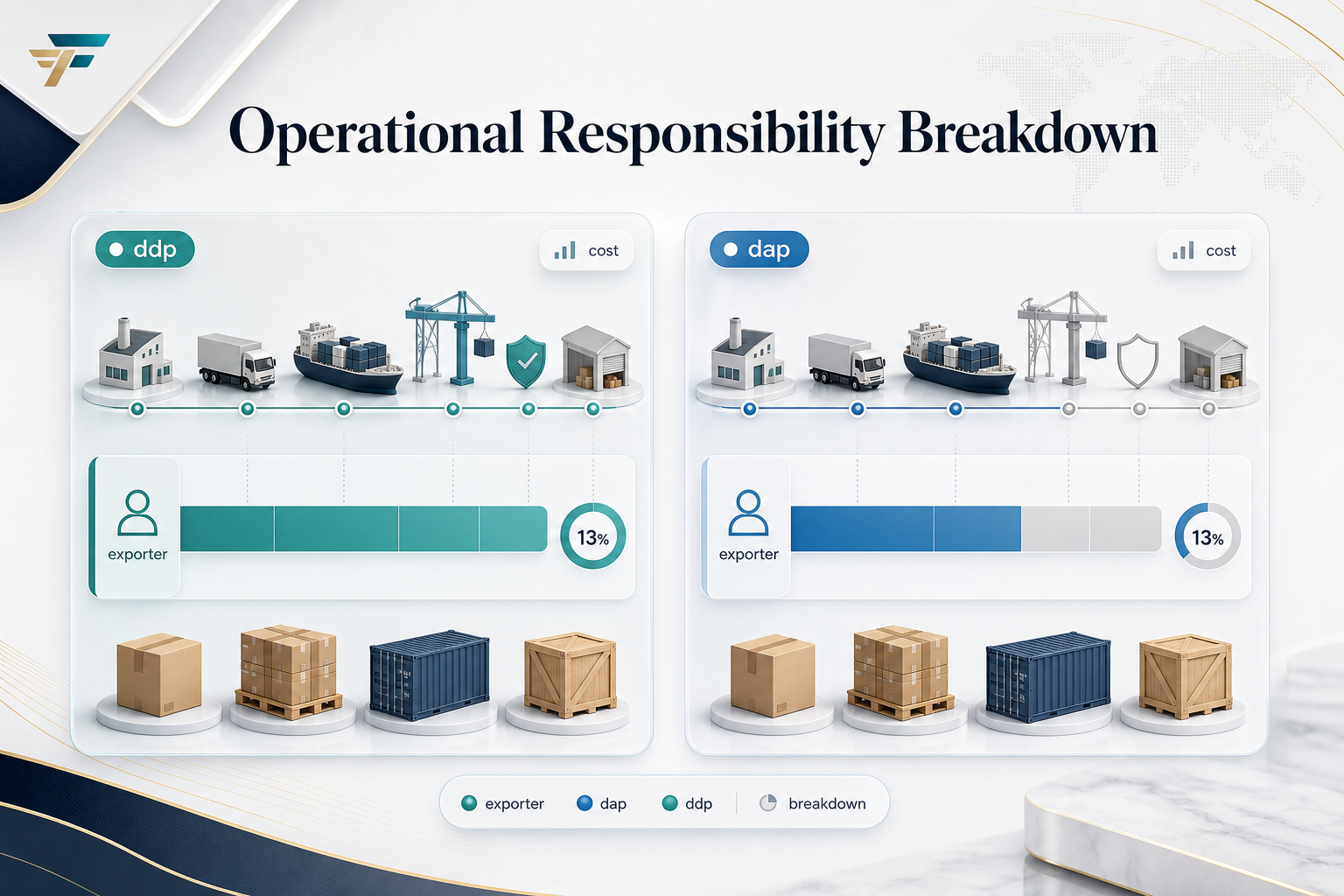
When people compare DDP vs DAP cost breakdown, money grabs attention fast. Still, the real driver behind cost differences is responsibility. Who handles paperwork? Who pays import tariffs? Who books the carrier? This Operational Responsibility Breakdown connects the dots inside the bigger DDP vs DAP cost breakdown conversation.
Export Customs Clearance
In any serious DDP vs DAP cost breakdown, export obligations start the story.
-
Export license approval
-
Customs declaration filing
-
Commercial invoice accuracy
-
Exit inspection compliance
Under both DDP and DAP:
-
The exporter manages China-side clearance.
-
The exporter prepares trade documents.
-
The exporter covers origin-side administrative costs and documentation fees.
Responsibility tree:
-
Exporter
-
Regulatory compliance
-
Commodity classification
-
Export control screening
-
-
Port operations
-
Terminal handling
-
Loading supervision
-
-
Cost exposure
-
logistics fees
-
Origin transportation costs
-
-
In short, export clearance barely shifts in the DDP vs DAP cost breakdown. The cost difference shows up later.
Import Customs Clearance
This is where the DDP vs DAP cost breakdown starts to widen.
Under DDP:
-
Exporter appoints broker
-
Exporter pays import tariffs, value-added tax (VAT), and customs surcharges
-
Exporter assumes inspection risk
Under DAP:
-
Importer clears goods
-
Importer pays levies and import fees
-
Importer handles compliance disputes
Cost comparison snapshot in a typical DDP vs DAP cost breakdown:
| Cost Item | DDP (USD) | DAP (USD) |
|---|---|---|
| Import Tariffs | 1,200 | 0 |
| VAT (13%) | 2,080 | 0 |
| Customs Broker Fee | 350 | 350 |
| Inspection & Compliance | 220 | 220 |
| Clearance Delay Storage | 480 | 480 |
In DAP, those first two lines shift directly to the buyer. That single shift changes the whole landed cost logic.
Documentation Handling
Paperwork sounds boring—until a missing line triggers storage charges.
Under DDP:
-
Exporter manages bill of lading
-
Exporter issues certificate of origin
-
Exporter ensures trade compliance
Nested responsibility view:
-
Core documents
-
Bill of lading
-
Commercial invoice
-
Packing list
-
-
Supporting documents
-
Certificate of origin
-
Compliance certificates
-
-
Risk impact
-
Delays
-
Extra documentation fees
-
Unexpected warehousing costs
-
Under DAP, import documentation pressure lands on the consignee. That shift often creates indirect delivery expenses and admin headaches—another subtle piece in the DDP vs DAP cost breakdown puzzle.
Freight Forwarder Coordination
Now we’re talking real transit costs and carrier drama.
DDP structure:
-
Exporter controls carrier booking
-
Negotiates carrier fees
-
Monitors fuel surcharges
-
-
Exporter arranges inland haulage
-
Final-mile delivery expenses
-
Schedule control
-
DAP structure:
-
Exporter covers main freight
-
Importer may coordinate destination haulage
-
Local trucking
-
Delivery appointment setup
-
Responsibility layering:
-
Freight booking
- Ocean or air contract
-
Inland movement
-
Origin trucking
-
Destination trucking
-
-
Risk management
-
Optional cargo insurance
-
Claims handling
-
Businesses working with FastShip China often prefer clarity here. Tight coordination reduces surprise logistics fees, which stabilizes the DDP vs DAP cost breakdown over time.
At the end of the day, the real DDP vs DAP cost breakdown isn’t just numbers. It’s about who owns the risk, who pays the taxes, and who stays up late fixing customs issues when something goes sideways.
Risk Allocation and Compliance Exposure
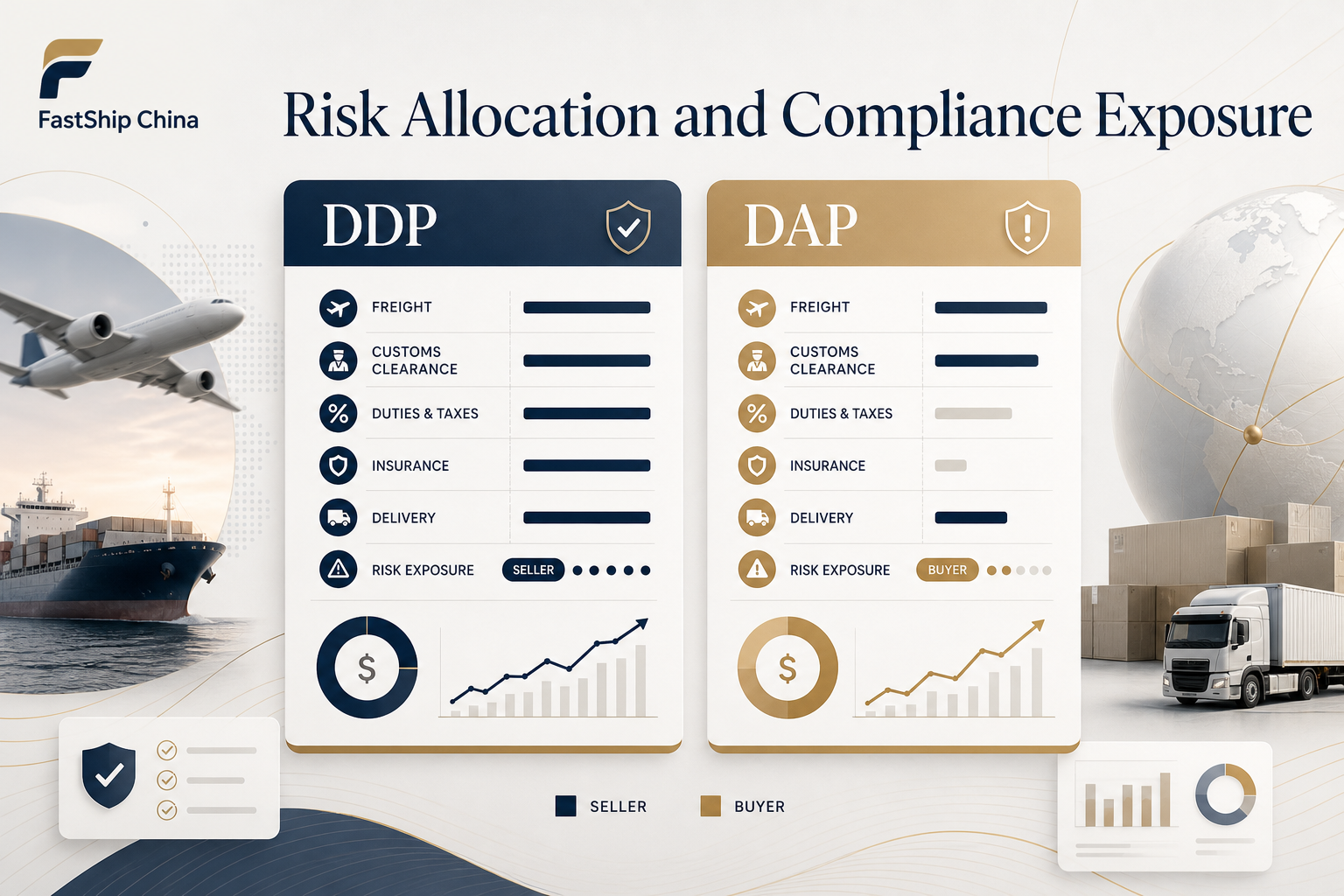
When comparing a DDP vs DAP cost breakdown, the real story isn’t just freight rates. It’s about who carries the legal heat, who pays when delays hit, and how insurance actually responds. A sharp DDP vs DAP cost breakdown makes risk visible, not hidden.
Customs Compliance Risk
In any serious DDP vs DAP cost breakdown, customs risk sits right at the top.
-
Under DDP (Delivered Duty Paid)
-
Exporter manages:
-
Duty rates calculations based on correct Tariff codes
-
Local Tax regulations in destination country
-
Accurate Customs valuation declarations
-
-
Exposure areas:
-
Penalties from Incorrect declarations
-
Reassessment during post-entry Reconciliation process
-
-
Financial impact:
-
Back payments of underpaid duties
-
Administrative fines
-
Broker correction costs
-
-
-
Under DAP (Delivered at Place)
-
Exporter handles:
- Export-side filing only
-
Importer manages:
-
Import Tariff codes and Duty rates
-
Destination Tax regulations compliance
-
-
Risk shift:
- Importer absorbs customs audits and reassessments
-
A 2025 WTO trade facilitation update noted that customs data errors remain a leading cause of cross-border penalties, especially where valuation disputes arise.
“Customs valuation disputes continue to generate significant post-clearance adjustments in global trade flows,” according to the World Trade Organization Trade Monitoring Report 2025.
For shippers running a tight DDP vs DAP cost breakdown, this means DDP carries deeper compliance exposure unless you’ve got a partner like FastShip China managing classification and filings cleanly.
Cargo Delay and Storage Risk
A proper DDP vs DAP cost breakdown also tracks what happens when cargo gets stuck.
-
Delay triggers
-
Port congestion
-
Random customs inspection
-
Missing paperwork
-
-
Cost layers under DDP
-
Demurrage charges at port
-
Storage fees in bonded warehouse
-
Extra Handling costs
-
Revised Inspection charges
-
-
Cost layers under DAP
-
Importer pays:
-
Terminal Storage fees
-
Extended Demurrage charges
-
-
Exporter risk ends at agreed delivery point
-
Look at it in tiers:
-
Arrival delay
- Terminal clock starts
-
Clearance hold
- Documentation fees rise
-
Release lag
- Daily storage stacks up
This is where the DDP vs DAP cost breakdown often flips. DDP exporters absorb compounding port costs; DAP shifts that exposure to the buyer. Many brands rely on FastShip China to monitor dwell time and push clearance fast, reducing runaway storage.
Insurance and Liability Coverage
Insurance can look simple on paper, yet the DDP vs DAP cost breakdown shows different risk transfer points.
-
Risk transfer under DDP
-
Seller responsible until goods reach final destination
-
Full transit insurance typically arranged
-
Coverage includes:
-
Damage during inland haulage
-
Loss during customs hold
-
-
-
Risk transfer under DAP
-
Seller liable until goods arrive at named place
-
Import duties excluded
-
Insurance clarity needed on:
-
Unloading responsibility
-
Local inland transfer
-
-
Now break down hidden cost elements that affect total liability exposure:
-
Overpayment factors:
-
Misapplied Duty rates
-
Incorrect Customs valuation
-
-
Clearance add-ons:
-
Unexpected Brokerage fees
-
Extra Inspection charges
-
-
Financial distortions:
-
Currency conversion swings
-
Market fluctuations affecting tax base
-
-
Commercial markups:
-
Service provider fees
-
Built-in Profit margins
-
Lack of Transparency issues
-
A clean DDP vs DAP cost breakdown, or even a simple DDP DAP cost comparison, should map insurance scope against these cost drivers. Without that, liability gaps creep in quietly.
In real-world shipping, the smarter move isn’t guessing. It’s structuring your DDP vs DAP cost breakdown around compliance depth, delay exposure, and insurance clarity—then aligning with experienced operators like FastShip China to keep risk tight and predictable.
Cash Flow and Pricing Strategy Impact
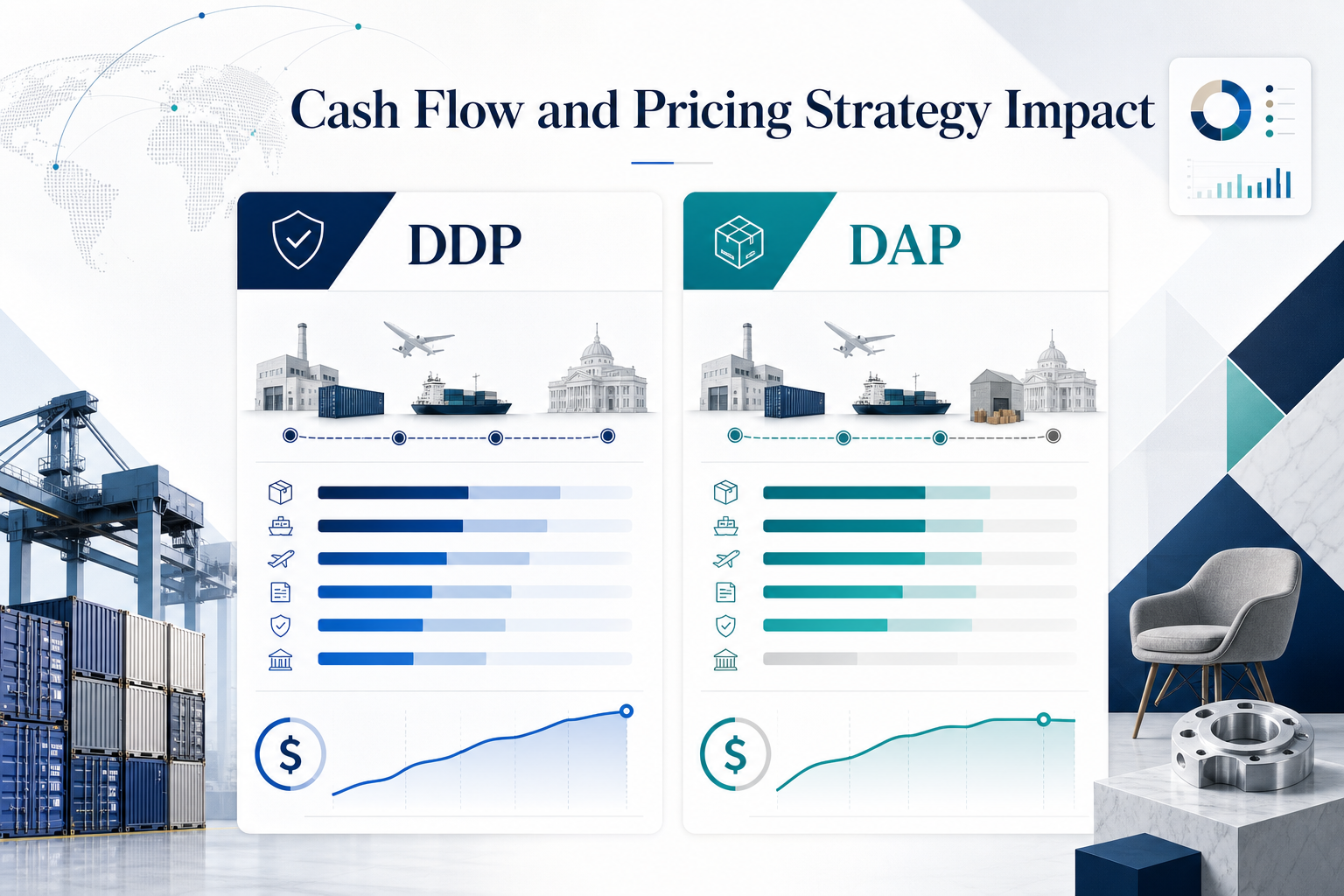
Understanding the DDP vs DAP cost breakdown is not just about freight math. It directly shapes cash flow, pricing strategy, and profit timing. When you compare DDP and DAP costs side by side, the numbers hit your bank account differently—and sometimes harder than expected.
Upfront Cost Burden
In any serious DDP vs DAP cost breakdown, the biggest contrast shows up at the payment stage.
-
Under DDP (Delivered Duty Paid):
-
Exporter prepays:
-
International freight
-
import duties
-
taxes (including VAT)
-
brokerage fees
-
Destination handling charges
-
-
Cash leaves before revenue lands.
-
Exposure increases if regulatory changes or surprise inspection requirements raise payable amounts.
-
-
Under DAP (Delivered at Place):
-
Exporter covers:
-
Freight to destination
-
Basic unloading arrangement (if agreed)
-
-
Importer handles:
-
import duties
-
taxes
-
Local brokerage fees
-
-
Cash burden shifts forward to buyer.
-
When comparing DDP and DAP costs, timing matters as much as totals. A typical DDP vs DAP cost breakdown may show similar final landed cost, yet the DDP model compresses liquidity because freight, customs clearance, and fiscal charges are prepaid.
If documentation errors delay clearance, prepaid funds sit idle. Add port congestion and longer processing times, and the exporter’s capital is locked in transit. That is why many sellers using FastShip China closely model the DDP vs DAP cost breakdown before confirming trade terms.
Pricing Transparency
Buyers love clarity. A clean DDP vs DAP cost breakdown makes that obvious.
With DDP:
-
One invoice.
-
All-inclusive pricing.
-
No surprise demurrage or detention fees later—if managed well.
With DAP:
-
Freight looks cheaper upfront.
-
Customs charges appear later.
-
Local agents add handling charges.
-
Final bill grows quietly.
According to the World Trade Organization’s 2024 Global Trade Outlook,
“Cost predictability remains a top concern for small and mid-sized importers, particularly in environments affected by regulatory shifts and port congestion.”
That lines up perfectly with real-world DDP vs DAP cost breakdown analysis. DDP improves landed cost visibility. DAP can look attractive in quotes but may hide downstream costs tied to inspection requirements or sudden regulatory changes.
Smart exporters break pricing into:
-
Base freight
-
Destination taxes
-
Customs-related service fees
-
Risk buffers
This makes the DDP vs DAP cost breakdown transparent, not just cheaper on paper.
Working Capital Pressure
The true weight of any DDP vs DAP cost breakdown shows up in working capital cycles.
-
Under DDP:
-
Cash Flow Timeline:
-
Pay freight
-
Prepay import duties
-
Cover destination handling charges
-
Wait for buyer payment
-
-
Risks:
-
Longer storage duration
-
Rising inventory volume
-
Added insurance during delay
-
-
-
Under DAP:
-
Cash Flow Timeline:
-
Pay freight
-
Deliver goods
-
Importer settles taxes and clearance
-
-
Reduced exporter exposure to:
-
Customs-related liquidity strain
-
Destination demurrage
-
Extended processing times
-
-
The DDP vs DAP cost breakdown becomes a financing decision. Exporters with strong reserves may prefer DDP for competitive pricing power. Smaller suppliers often choose DAP to protect liquidity.
FastShip China helps businesses simulate DDP and DAP cost scenarios before shipment, mapping out duty timing and identifying where working capital gets squeezed. A proper DDP vs DAP cost breakdown does more than compare charges—it protects cash, pricing credibility, and long-term stability.